
Irish credit unions are entering a decisive phase in digital operational resilience. The Central Bank's IT Thematic Review has made one point clear: ICT governance, third-party risk oversight and resilience assurance must materially strengthen at board level. While DORA applies fully to most EU financial entities from January 2025, Irish credit unions are on a phased pathway, with full alignment expected by 2028 — and supervisory expectations are already converging with DORA principles.
For management bodies, the strategic question is no longer whether to align with DORA — but how to do so proportionately, defensibly and with clear board oversight.
CRI – Cyber Risk International supports the credit union community through CUdora.ie — a structured, board-focused pathway powered by CyberPrism that moves organisations from thematic review findings to DORA-aligned resilience with clarity and evidence.
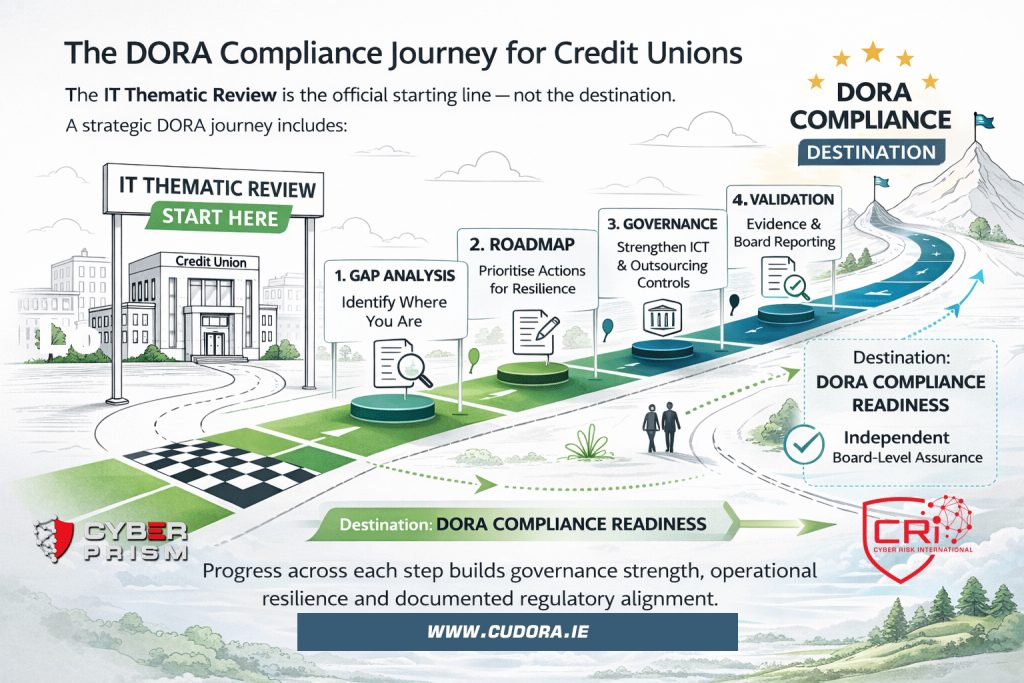
Across Ireland, management bodies are asking the same question: "Are we responding to the Central Bank's IT Thematic Review… or are we preparing for DORA?"
At first glance, they can feel like two different roads — one labelled "IT Thematic Review", the other labelled "DORA Journey". In truth, they are not competing paths. They are the same road — sequenced properly.

The IT Thematic Review can feel immediate, supervisory, and reactive. DORA can feel strategic, European, and future-dated. But in reality:
The fork in the road is not between two different directions. It is between treating the Thematic Review as a short-term regulatory response — or recognising it as the diagnostic starting point of your DORA journey.
The Central Bank has already indicated where it sees sector-wide weaknesses: ICT governance maturity, board-level oversight, risk documentation, outsourcing control, and evidence of challenge. DORA reinforces those same areas under a structured legal framework.
The Thematic Review is not separate from DORA. It is the early visibility phase of the same resilience expectation.
The strategic question is not "Which path do we take?" It is "Do we respond tactically — or do we respond structurally?"
"The management body of the financial entity shall define, approve, oversee and be accountable for the implementation of all arrangements related to the ICT risk management framework."
— DORA, Article 5(2)One of the most important mindset shifts is this: this is not an IT issue. Under DORA, the management body is collectively responsible, individually accountable, required to approve ICT risk frameworks, and expected to evidence oversight. The fork in the road, therefore, is not technical. It is governance-led.
Approached correctly, the IT Thematic Review becomes your baseline diagnostic, your governance stress test, your early-warning indicator, and your opportunity to structure compliance correctly — the first stage of your DORA journey, not a distraction from it.
If the IT Thematic Review is the starting line, then the first disciplined step is clear: you must establish your current position. Not instinctively. Not informally. Not through reassurance. But through structured, documented analysis.
"Members of the management body shall actively keep up to date sufficient knowledge and skills to understand and assess ICT risk and its impact on the operations of the financial entity."
— DORA, Article 5(4)Too often, "gap analysis" is treated as a technical audit. Under DORA, it is something far more significant: a board visibility exercise — a governance exercise, not an IT exercise. It answers five critical questions for the management body:
This is not about whether controls exist. It is about whether governance oversight can be evidenced.
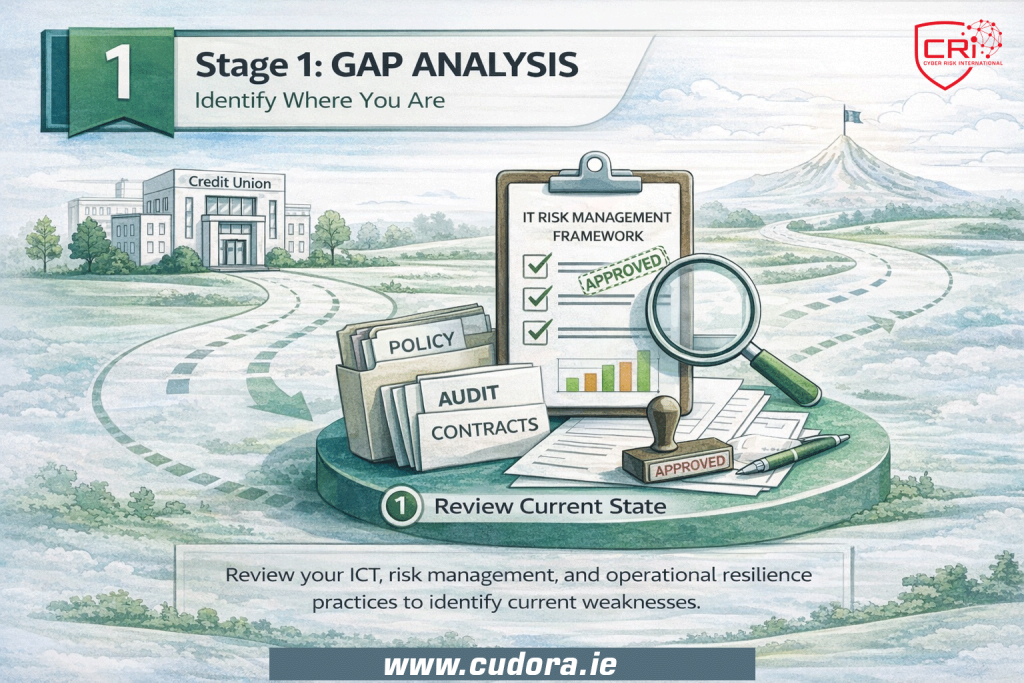
Without a structured gap analysis, boards typically fall into one of three traps: assuming operational teams are "handling it," implementing improvements without prioritisation, or discovering weaknesses during supervisory engagement. All three create unnecessary regulatory exposure. A proper gap analysis provides clarity, prioritisation, board confidence, and a defensible position.
Map existing governance, ICT and outsourcing controls against DORA requirements, Central Bank supervisory expectations, and proportionality thresholds.
Distinguish between documentation gaps, governance gaps, operational control gaps, and outsourcing oversight gaps. Not all gaps carry equal risk — board time must focus on material exposure.
Provide a clear answer to "What is our current DORA readiness level?" Without a quantified baseline, roadmap planning lacks credibility.
The output must be structured, board-reportable, regulator-ready, and capable of demonstrating active oversight.
"Financial entities shall implement the ICT risk management framework referred to in Article 6 in a manner that is proportionate to their size and overall risk profile, and to the nature, scale and complexity of their services, activities and operations."
— DORA, Article 6(1)Irish credit unions operate under proportionality constraints, limited internal ICT resource depth, cost sensitivity pressures, and increasing supervisory scrutiny. A generic DORA gap analysis is therefore insufficient. What is required is a credit union–specific lens, alignment with the Central Bank's IT Thematic Review themes, and a pathway to roadmap generation. Gap analysis should not end in a report — it should lead directly into structured action planning.
A rigorous Stage 1 lets boards move from reactive to structured planning, avoid duplicated remediation, sequence investments rationally, align with 2028 expectations early, and reduce long-term supervisory risk. Most importantly, it transforms regulatory uncertainty into measurable governance progress. Once the board knows where it stands, where weaknesses exist, and what regulatory exposure remains, the next logical step becomes: "How do we prioritise and sequence action?"
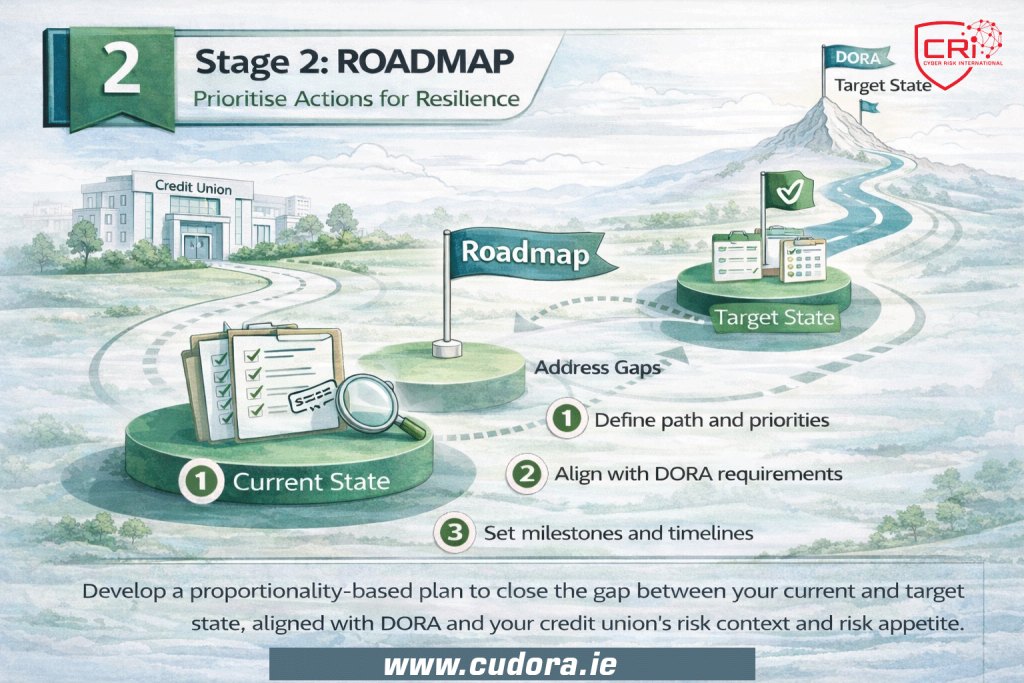
Once a credit union has completed a structured gap analysis, two positions become clear: your current state — evidenced, documented, measurable — and your target state — defined by DORA requirements and supervisory expectations. The question then becomes: how do we move between the two — intelligently, proportionately, and without unnecessary disruption?
A DORA roadmap is a governance instrument — not a project plan. It is a board-approved, risk-aligned progression plan that sequences remediation activity, aligns actions to regulatory timelines, embeds proportionality, reflects the credit union's size, complexity and outsourcing profile, and respects the board's defined risk appetite. Without this structure, remediation becomes reactive and fragmented.
Alignment with DORA's five pillars, integration with Central Bank supervisory themes, explicit mapping to ICT governance obligations, and board-level approval of the resilience framework. The target state must be specific — not generic.
DORA is explicit: implementation must be proportionate to the nature of activities, size, risk profile and degree of outsourcing. The roadmap must avoid over-engineering controls, importing large-bank frameworks, or creating compliance burden that exceeds operational reality.
Not all gaps are equal. Categorise remediation by regulatory exposure, operational impact, outsourcing risk concentration, board oversight weaknesses, and dependency on third-party ICT providers. Priority should follow risk — not convenience.
With full compliance required by January 2028: stage governance strengthening early, address outsourcing controls in a structured phase, plan resilience testing capability, and build reporting maturity progressively. Multi-year sequencing avoids late-stage regulatory compression.
This is where many institutions fail. The management body must demonstrate that remediation decisions reflect defined risk tolerance, ICT investment aligns to strategic risk posture, and outsourcing oversight matches concentration risk. The roadmap becomes evidence of controlled progression — not reactive correction.
Credit unions that formalise their roadmap early gain stability in planning cycles, improved board confidence, clear communication to the Central Bank, reduced duplication of work, and a lower long-term cost of compliance. It transforms DORA from an abstract obligation into a controlled governance programme — and prevents the last-minute scramble that characterises poorly sequenced regulatory implementation.
"Financial entities shall clearly define and document roles and responsibilities for all ICT-related functions and for ICT risk management."
— DORA, Article 13(1)If Stage 1 provides clarity and Stage 2 provides direction, Stage 3 delivers substance. This is where governance is strengthened, oversight becomes demonstrable, and regulatory assurance begins to take shape.
For Irish credit unions, this stage is not about building complex IT architecture. It is about ensuring the management body can evidence clear accountability, active oversight, structured challenge, proportionate control, and documented assurance.
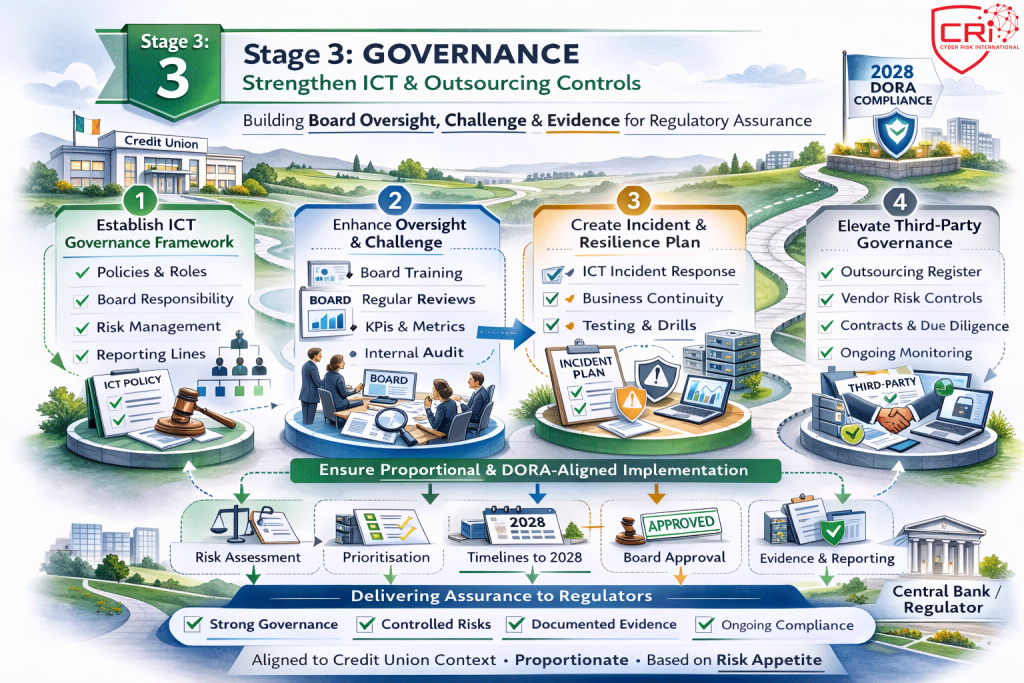
A formal framework defining roles and responsibilities, ICT risk management structure, reporting lines, policy approval processes, and alignment with risk appetite. Not an operational manual — a governance structure approved by the board and capable of withstanding supervisory scrutiny. The Central Bank will expect to see evidence that ICT risk is governed — not simply managed.
Oversight is not passive receipt of reports. It requires regular ICT risk reporting, defined KPIs and KRIs, formal review cycles, evidence of challenge and discussion, and board education on DORA obligations. Minutes must demonstrate questioning, escalation, action tracking and follow-up — challenge must be visible, structured, and recorded.
For many credit unions, ICT outsourcing represents the highest concentration of risk. DORA places significant emphasis on outsourcing registers, contractual protections, due diligence, ongoing monitoring, and exit strategy planning. The board must be confident that critical ICT providers are identified, dependencies understood, concentration managed, and oversight proportionate.
Resilience is not simply having an incident response document. It requires a structured ICT incident management framework, business continuity alignment, defined escalation pathways, testing and simulation exercises, and lessons-learned documentation. Resilience mechanisms must not be theoretical — they must be tested and evidenced.
Perhaps the most overlooked aspect of Stage 3 is documentation discipline. Without evidence, governance does not exist in the eyes of the regulator. Boards must be able to produce approved policies, risk assessments, oversight records, challenge documentation, internal audit findings, remediation tracking, and regulatory reporting records. This is what transforms governance from intention into assurance.
"The management body shall adopt and regularly review a strategy on ICT third-party risk."
— DORA, Article 28(2)When properly executed, Stage 3 provides strong governance structures, controlled and proportionate risk, demonstrable board oversight, documented evidence, and increased supervisory confidence. It is at this stage that the board transitions from preparing for DORA to being able to demonstrate alignment with it — reducing regulatory anxiety, avoiding compressed remediation later, and building resilience beyond compliance.
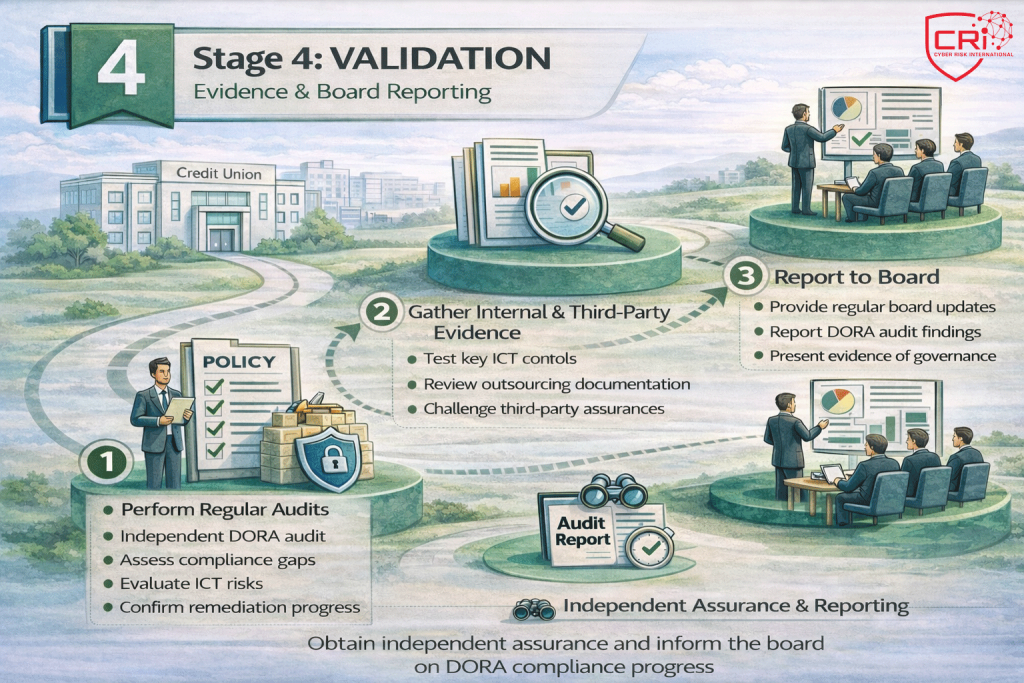
If Stage 3 embeds governance, Stage 4 proves it. Validation is the point at which a credit union must be able to demonstrate that controls are not merely designed — they are operating; oversight is not assumed — it is evidenced; assurance is not informal — it is structured and documented.
The Central Bank will not rely on statements of intent. It will expect objective evidence.
Validation begins with independent scrutiny: internal audit review of ICT governance and DORA controls, assessment of remediation progress against the roadmap, testing of key ICT risk management processes, evaluation of outsourcing oversight effectiveness, and confirmation that policies are implemented in practice. Audit findings must be risk-rated, action-tracked, reported formally, and closed with documented evidence. Validation is not a one-off exercise — it becomes part of the ongoing governance cycle.
"Financial entities shall establish, maintain and review a sound and comprehensive digital operational resilience testing programme."
— DORA, Article 24(1)Evidence is the currency of regulatory assurance.
Third-party risk is a supervisory priority. Boards must not simply receive vendor assurances — they must challenge them and record that challenge.
Structured reporting should provide: current DORA readiness status, outstanding gaps and remediation timelines, audit findings and risk exposure, outsourcing risk summaries, incident and resilience testing outcomes, and evidence of proportional implementation. Board reporting must allow directors to understand ICT risk exposure, challenge management where required, approve corrective action, and demonstrate informed oversight. Minutes must reflect discussion, scrutiny and direction — this is what transforms compliance activity into defensible governance.
"Financial entities shall provide competent authorities with all information necessary to enable them to assess compliance with this Regulation."
— DORA, Article 50(1)When properly executed, validation provides independent assurance, documented evidence of control effectiveness, structured board reporting, reduced supervisory uncertainty, and a credible position approaching 2028. At this stage, the credit union is no longer preparing for DORA — it is able to demonstrate alignment.
Reaching DORA compliance is not the end of a project. It is the point at which a credit union can demonstrate that digital operational resilience is governed, controlled, evidenced, proportionate, and board-owned.
Compliance is not a certificate. It is a position of defensible governance.
The board understands its responsibilities under DORA and can evidence structured oversight of ICT risk.
Critical third-party dependencies are identified, monitored and governed — not assumed.
Controls are aligned to the credit union's size, complexity and risk appetite — not copied from larger institutions.
Incident response and business continuity arrangements are not theoretical. They have been exercised and improved.
If the Central Bank requests evidence tomorrow, it can be produced. That is what compliance looks like in practice.
January 2028 is a milestone — not a finish line. Post-compliance governance requires ongoing oversight, regular validation, continuous improvement, monitoring of regulatory developments, and adaptation to evolving threat landscapes. Resilience is dynamic; compliance must be sustained.
There is a broader point often overlooked: well-governed digital resilience strengthens member confidence, enhances operational stability, reduces incident impact, improves regulatory relationships, and supports sustainable growth. DORA should not be viewed as regulatory burden alone. It is a catalyst for governance strengthening.
Having walked the journey — Start Line → Gap Analysis → Roadmap → Governance → Validation — the real question becomes: Is our DORA position structured, proportionate and defensible? Credit unions that approach this journey methodically will reach compliance with clarity. Those that treat it as a deadline exercise may find themselves revisiting weaknesses under supervisory pressure.
"Financial entities shall at all times remain fully responsible for compliance with, and discharge of, all obligations under this Regulation."
— Regulation (EU) 2022/2554 (DORA), Article 28(1)Final thoughts: digital resilience does not emerge from isolated documents. It emerges from structured, sector-aware implementation. For Irish credit unions, the journey is navigable — when sequenced properly, governed actively and validated independently. That is what turns regulatory obligation into operational strength.
The CUDORA service provides a structured and proportionate pathway from IT Thematic Review findings to DORA-aligned resilience. It supports boards by:
A DORA-aligned assessment of ICT governance, third-party oversight and incident management maturity.
Clear reporting dashboards and evidence trails aligned to DORA Articles and supervisory expectations.
A phased roadmap aligned to the 2028 pathway, reducing compressed implementation risk.
Structured criticality assessments and oversight mechanisms aligned to DORA requirements.
Continuous visibility of digital resilience posture — not a one-off compliance exercise.
Ten questions every management body should be able to answer — with the DORA Article that mandates each, and how CUDORA helps.
Start your structured, board-focused pathway from the IT Thematic Review to DORA-aligned resilience.